Puppeteer AI vs Vapi vs Retell: Infrastructure or a Workflow Partner?

Puppeteer AI vs Vapi vs Retell: Infrastructure or a Workflow Partner?
Teams evaluating AI voice agents often end up looking at Puppeteer AI, Vapi, and Retell side by side.
At a glance, all three support AI-driven phone conversations. The real differences show up later, once these systems are live, touching real patients, real schedules, and real operations. Especially in healthcare, those differences matter.
This comparison is less about audio quality or model choice and more about ownership. Who builds the system, who maintains it, and who is responsible when things go wrong.
The key question is responsibility, not voice quality
Most product comparisons focus on latency, transcription accuracy, or which LLM sits behind the agent. Those details matter, but they are rarely the deciding factor in production.
The more important question is simple:
Who owns the outcome once the agent is answering real calls?
Vapi and Retell: tools for building voice systems
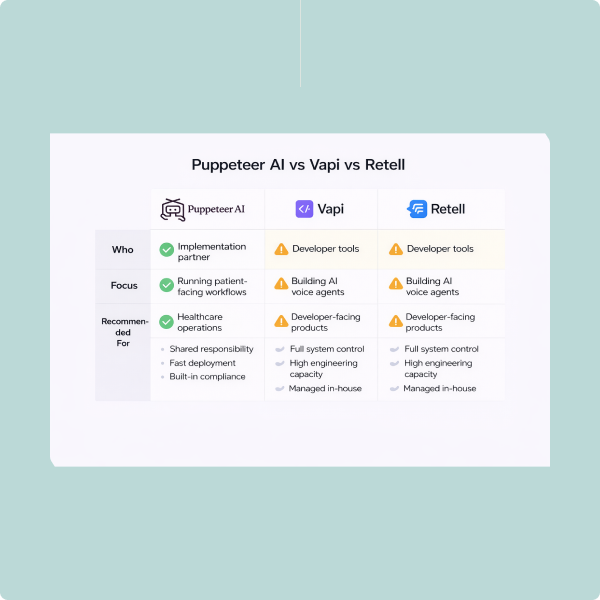
Vapi and Retell are designed as developer-first voice infrastructure. They provide the core building blocks for real-time calling and conversational control, and they do that well.
What they intentionally do not provide is guidance or structure around:
- How calls should map to business workflows
- What happens after a conversation ends
- When and how humans step in
- How compliance is enforced in regulated environments
This approach works for teams building horizontal products or experimenting with conversational interfaces. It gives full control, but it also means everything beyond the call itself is up to the team implementing it.
You get flexibility, along with full responsibility.
Puppeteer AI: designed to run workflows, not just calls
Puppeteer AI operates at a different layer.
Instead of offering primitives for building agents, Puppeteer focuses on running patient-facing workflows alongside healthcare teams. The emphasis is not on how the agent sounds, but on what needs to happen next.
On the Puppeteer AI platform, voice agents are built around scheduling logic, intake flows, follow-ups, escalation paths, and handoffs to staff. These workflows are owned, monitored, and refined over time, in partnership with the organization using them.
That changes the relationship. Puppeteer is not just a vendor supplying tools, it acts as an implementation partner with shared accountability for outcomes.
Why healthcare shifts the decision
In healthcare, communication does not exist in isolation. Every call touches systems shaped by regulation, privacy requirements, and patient safety expectations.
Any AI handling patient conversations must account for HIPAA compliance, secure handling of protected health information, and processes that align with standards set by regulators like the U.S. Department of Health & Human Services.
With infrastructure platforms such as Vapi or Retell, these safeguards must be designed, implemented, and maintained internally. Puppeteer bakes these considerations into how workflows are structured and operated, reducing the load on internal teams.
When Vapi or Retell make sense
Vapi or Retell are strong choices if:
- You are building a developer-facing product
- You want low-level control over every interaction
- You have the engineering capacity to handle edge cases
- Compliance and reliability are managed internally
In these scenarios, infrastructure tools provide a solid foundation.
When Puppeteer AI is the better fit
Puppeteer AI is typically a better fit for teams that want:
- Faster deployment
- Fewer internal dependencies
- Shared accountability for results
- Continuous iteration tied to real operations
Common use cases include patient intake, scheduling and rescheduling, after-hours call coverage, no-show recovery, and follow-up outreach. These patterns are explored in more detail on the Puppeteer healthcare AI blog.
Instead of asking teams to assemble systems from scratch, Puppeteer delivers agents designed to work inside existing healthcare operations from day one.
Building agents vs running workflows
One way to frame the decision is this:
- Vapi and Retell help teams build AI agents.
- Puppeteer AI helps teams run AI-powered workflows.
Both approaches are valid. The right choice depends on whether your organization wants to own infrastructure or work with a partner responsible for execution.
Final thoughts
When comparing Puppeteer AI vs Vapi vs Retell, the deciding factor is rarely technical capability alone. It is about who carries the operational load once the agent is live.
Infrastructure tools prioritize flexibility.
Workflow partners prioritize reliability and outcomes.
In healthcare, that distinction often matters more than anything else.
Let’s build your next care agent together
Get a 20-minute call with our team to explore how Puppeteer AI can support your clinical workflows with custom AI agents.



Last Articles




Real Usecases, Real Results
See how healthcare teams use Puppeteer AI to automate patient conversations, reduce workload, and deliver better care, from intake to reactivation.