Longevity + AI Webinar: Main Insights

Longevity + AI Webinar: Main Insights
The longevity field is full of exciting science. What it's shorter on is honest conversation about what it actually takes to get that science to people at scale, at price points that matter, and in a way that holds up in the real world. We brought together three people building at the center of that problem and asked them all about it. Here's what stood out the most.
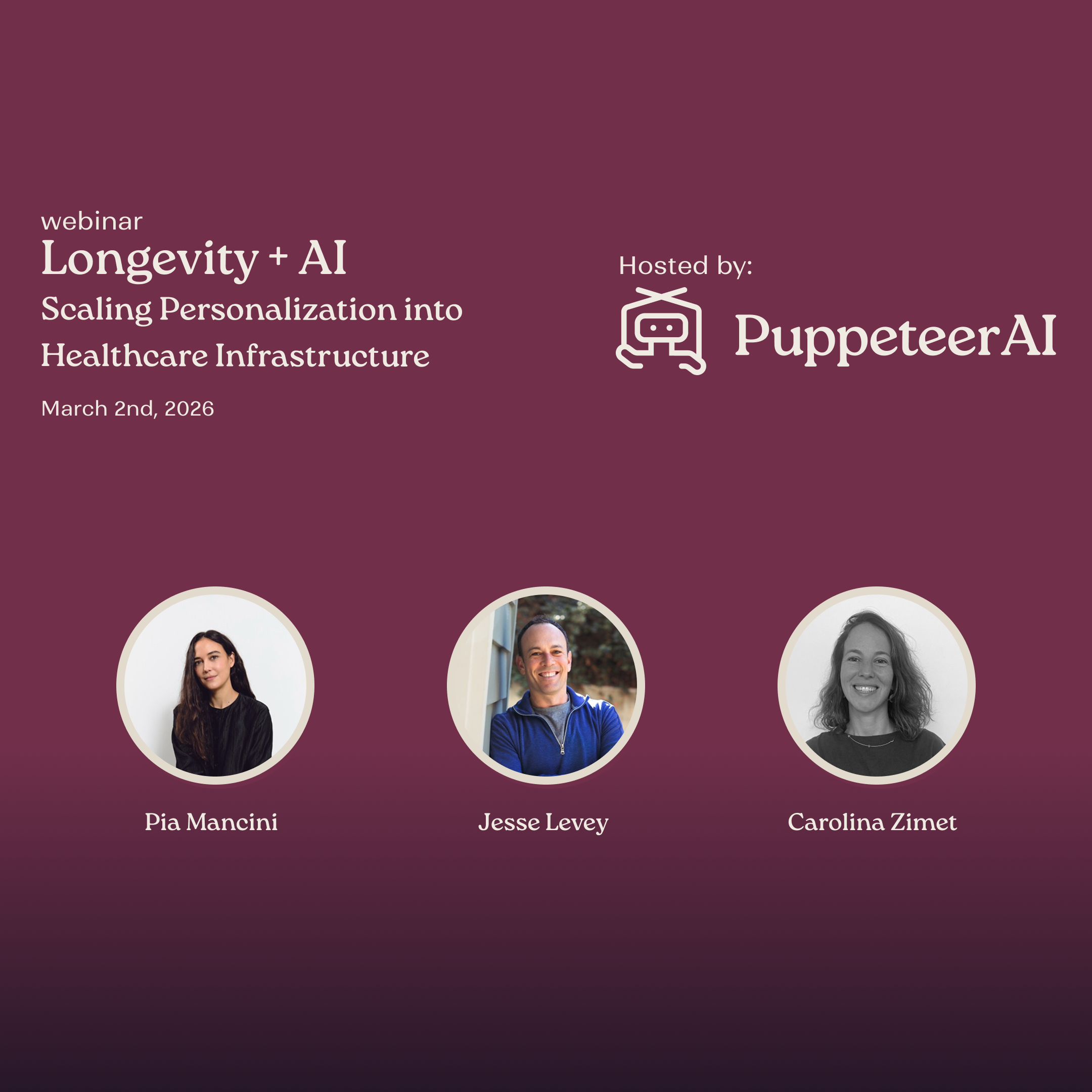
The Panelists
Jesse Levey is Founder and CEO of Longevity Health, which he started after his own frustrating experience trying to build a structured, science-based longevity program for himself. His personal goal: ski in his 80s and hike in his 90s. He lives in Lafayette, California with his wife, three kids, a dog, and 15 chickens.
Pia Mancini is Founder and CEO of Give Zero. She started building it at 37, when debilitating migraines and a family history of Alzheimer's sent her looking for answers about perimenopause. After years of being told she was too young and her labs were fine, she stopped waiting for the system to catch up. Give Zero is the resource she wished she'd had.
Carolina Zimet is Managing Partner at Panmabí Ventures. She is an economist and CFA with a decade at Merrill Lynch managing portfolios across Latin America. She pivoted from finance to founding companies in Uruguay and Mexico before turning to early-stage investing. Her thesis is simple: technology and well-being, combined, can build a better world.
The Core Tension: Personalization vs. Scale
The conversation opened with the central problem of the whole space: longevity medicine promises care built around your biology, your genes, your goals; but healthcare systems scale by running on standardized protocols that apply to everyone. How do you build a bridge between the two?
Jesse's answer was grounded in his day-to-day at Longevity Health. In longevity, he argued, there are essentially no universal prescriptions. Everybody needs sleep, everybody needs to eat, people should exercise. But the specifics of what each one of us should do are different, shaped by individual biology, history, and goals. That's the entire clinical premise.
The problem is that truly individualized care has historically required enormous amounts of clinician time, which is why it's been confined to expensive, niche programs. AI changes the math. It can synthesize data from biomarkers, wearables, and lab results into personalized recommendations at a speed no human team can match alone. The clinician's role shifts from doing that synthesis manually to reviewing, validating, and acting on what the AI surfaces. That's where the scale potential lives.
The Cost Problem Has Specific Numbers
Top-tier longevity programs have historically cost up to $100,000 per year. Longevity Health brought that down to $10,000. A significant drop, but still out of reach for most people and impossible to run through insurance. The real threshold, Jesse argued, is somewhere around $1,000–$1,500 per year. Get below that, and you can start having conversations with health plans and employers about coverage. Stay above it, and you're permanently a product for the affluent few.
AI is the mechanism that makes that cost reduction possible. Not by cutting corners on care, but by dramatically reducing the time clinicians spend on tasks that don't require their expertise (administrative work, routine check-ins, synthesizing data from wearables and labs into something actionable). The clinician's time gets used on the decisions that actually need a clinician.
This reframes what "AI in healthcare" means in practical terms. It's not about replacing doctors. It's about making the economics of personalized care work at a price point where it can reach most people.
Longevity’s Gender Gap
Pia raised a topic that rarely gets adequate attention in longevity conversations: the systematic underfunding and misunderstanding of female biology in medicine, and specifically what happens to women during perimenopause.
Her core point: perimenopause doesn't have a formal diagnosis in most healthcare systems. There's no standard protocol. When women start experiencing symptoms — cognitive changes, sleep disruption, changes in energy and mood — they're often told it's stress, or anxiety, or just aging. The care gap is enormous and largely invisible.
Give Zero was built to address exactly this. The platform helps women identify patterns in their symptoms, connect the dots between what they're experiencing and what their hormone data and wearables are showing, and get guidance that's actually calibrated to where they are in their biological journey, not what's standard for their age cohort on average.
Pia pointed out the responsibility this creates: when your users are coming to you because the medical system has nothing useful to offer them, the bar for accuracy and transparency is exceptionally high. Companies operating in these neglected spaces carry a particular burden to get it right.
AI filling gaps that traditional medicine has simply failed to address is one of the more compelling use cases in the longevity space.
The Adherence Problem
Carolina made a great practically useful observation: longevity solutions need to be designed for a world where people don't follow instructions perfectly, because that is the only world that exists.
Patients won't take their supplements every day at the right time. They won't sleep on the schedule the protocol says. They won't maintain a perfect diet. Designing a longevity program that only works for someone who does everything right is designing a program that won't scale.
This matters especially in contexts where bandwidth is genuinely limited. Carolina gave a specific example: in Latin America, many healthcare workers are doing 12–14 hour shifts. After that, they don't have the cognitive or physical capacity to cook according to a nutrition plan or engage with a complex wellness protocol. AI that doesn't account for this, that just pushes recommendations without meeting people where they actually are, is AI that will be abandoned.
The solutions with staying power, she argued, are the ones that can produce meaningful outcomes even under conditions of imperfect adherence and incomplete data. That's a harder design brief than building for the motivated, health-literate early adopter. But it's the brief that actually matters for scale.
Latin America: Longevity as a Public Problem, Not a Premium One
In Latin America, longevity isn't primarily a question of individual optimization. It's an economic and public health problem that governments have a direct stake in solving. Populations are living longer, but not better. Chronic disease is pulling people out of the workforce in their 40s and 50s. The fiscal burden on healthcare and pension systems is real and growing.
This means the companies most likely to gain traction in the region aren't the ones pitching red-light therapy and elite biomarker panels. They're the ones who can walk into a government or health ministry conversation and make a credible case that their solution reduces systemic cost — that healthier populations mean fewer hospitalizations, longer productive working lives, lower public health expenditures.
She also pointed to AI's specific promise in this context: the ability to deliver behavioral support and personalized guidance to people who have no access to a specialist and no time for a premium wellness program. That is a genuinely different market than the one most longevity companies are currently building for and, in Carolina's view, a much bigger one.
The Regulatory Gap
Pia operates primarily in Europe, and she had a lot to say about what that means practically.
The EU's regulatory environment for digital health is the most demanding in the world. Under current EU rules, a health app wanting to move into diagnostic territory would go through the same regulatory process as an implantable medical device.
By contrast, the FDA has developed expedited pathways specifically for digital health applications. That structural difference creates a real competitive disadvantage for European longevity startups that is unlikely to change quickly.
Jesse added the operational layer: even beyond regulation, getting longevity tools into mainstream healthcare requires deep integration work: connecting to EHR systems, fitting into clinical workflows, getting onto health plan formularies. Most of that work is unglamorous and underestimated. It's where promising products stall.
What We Took Away
The clearest throughline across the whole conversation was this: the hard part of longevity isn't the science. It's everything else.
It's making the economics work so products can reach the people who need them, not just those who can pay. It's building for real-world adherence rather than ideal compliance. It's filling gaps that traditional medicine has chronically neglected. It's closing the loop between AI insight and clinical action. And it's doing all of that within regulatory frameworks that are still being written.
Watch the full webinar recording here.
Let’s build your next care agent together
Get a 20-minute call with our team to explore how Puppeteer AI can support your clinical workflows with custom AI agents.



Last Articles




Real Usecases, Real Results
See how healthcare teams use Puppeteer AI to automate patient conversations, reduce workload, and deliver better care, from intake to reactivation.