Healthcare Waitlist Backfilling: Filling Cancellations with AI

Healthcare Waitlist Backfilling: Filling Cancellations with AI
Last-minute cancellations leave clinics with empty slots, lost revenue, and patients still waiting. Traditional waitlists can’t move fast enough to recover that capacity.
This article explains how Puppeteer's automated waitlist backfilling helps clinics turn open slots into confirmed visits without adding manual work.
Schedule some time with us to explore the solution.
As the year winds down and holidays approach, healthcare clinics and hospitals often see a familiar pattern: patients cancel appointments at short notice, leaving open slots on the calendar that are difficult to refill in time.
At the same time, many organizations maintain long waitlists of patients who would gladly take an earlier appointment.
This disconnect of empty appointment slots alongside waiting patients is not a demand problem. It’s an operational one. And it’s exactly the gap Puppeteer AI’s waitlist backfilling is designed to close.
Why Appointment Cancellations Create Unused Capacity
Appointment cancellations are a routine part of outpatient care, but their operational impact is often underestimated.
Harris et al. (2020) analyzed how outpatient clinic cancellations affect scheduling strategies and capacity, noting that cancellation behavior — which can occur at rates as high as 27% — must be incorporated into scheduling models to avoid wasted slots and inefficiencies.
Late cancellations compress the response window. Even when a waitlist exists, clinics must quickly: identify clinically appropriate patients, confirm availability and constraints, reach patients individually, update schedules, and document outcomes.
In practice, many of these openings simply go unfilled.
When a canceled appointment is not refilled, the impact extends beyond a single missed visit:
- Lost clinical capacity that cannot be recovered later
- Administrative burden as staff attempt manual backfilling
- Delayed access to care for patients already waiting
- Revenue leakage that compounds over time
At a system level, unused outpatient capacity is widely recognized as contributing to broader healthcare inefficiency. Missed and unused appointments cost the U.S. health care system more than $150 billion annually (Chen, 2023) with each open, unused timeslot representing lost opportunity for care delivery.
Why Traditional Waitlists Fail to Recover Cancelled Appointments
Most clinics already maintain waitlists. But traditional waitlists are static as they were not designed to respond in real time.
When a cancellation happens hours or days before a visit manual outreach is slow, patients may not answer, staff availability is limited, and documentation adds friction.
As a result, waitlists often exist in the EHR without functioning as true capacity recovery tools.
In practice, this means cancellations create a narrow time window in which capacity can be recovered but manual workflows can’t move fast enough to consistently capture it.
What’s missing is an automated, rules-based way to immediately convert a cancellation into a confirmed visit.
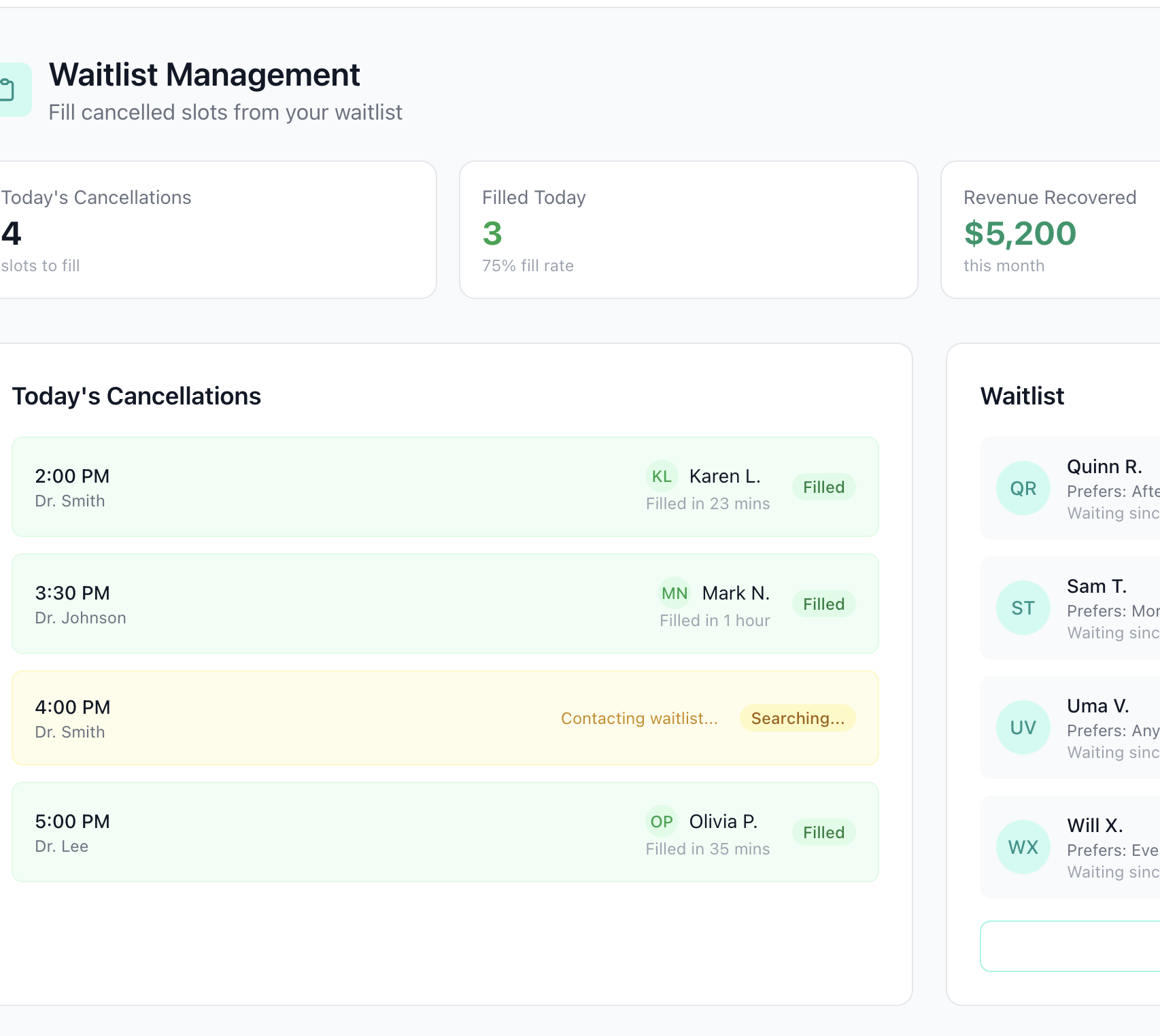
Puppeteer’s waitlist backfilling is an automated scheduling workflow that fills newly opened appointment slots by offering them to eligible patients who already have future appointments.
What you gain when Puppeteer AI Fills Cancelled Appointments Automatically
1) Fewer empty calendar slots
Backfilling targets the most painful loss: the short-notice opening that would otherwise go unused.
2) Less manual work for staff
Instead of calling down a list and documenting each attempt, staff can focus on higher-value tasks .
3) Better patient experience and earlier care
Patients who are waiting and want an earlier appointment are often happy to move up
4) A workflow that holds up during high-volatility periods
When cancellations spike, automated backfilling can act as a stability layer, helping your team avoid the scramble.
Every canceled appointment represents a choice: accept lost capacity or act fast enough to recover it. By acting immediately when a slot opens, clinics can recover appointments, protect revenue, and improve patient access.
Let’s build your next care agent together
Get a 20-minute call with our team to explore how Puppeteer AI can support your clinical workflows with custom AI agents.


Last Articles



Real Usecases, Real Results
See how healthcare teams use Puppeteer AI to automate patient conversations, reduce workload, and deliver better care, from intake to reactivation.