The Front Desk Is the New Front Line of Patient Care

The Front Desk Is the New Front Line of Patient Care
Every healthcare leader knows the number that quietly decides whether clinical schedules stay full: the one nobody picks up.
A patient calls to book a follow-up, gets voicemail, and moves on. Another cancels the night before and the slot goes dark. A third has a simple question about their intake forms and, with no one to answer, disappears from the funnel before they ever become a visit. None of this shows up in a clinical quality report. All of it shows up in revenue, in access, and — further downstream than most dashboards reach — in outcomes.
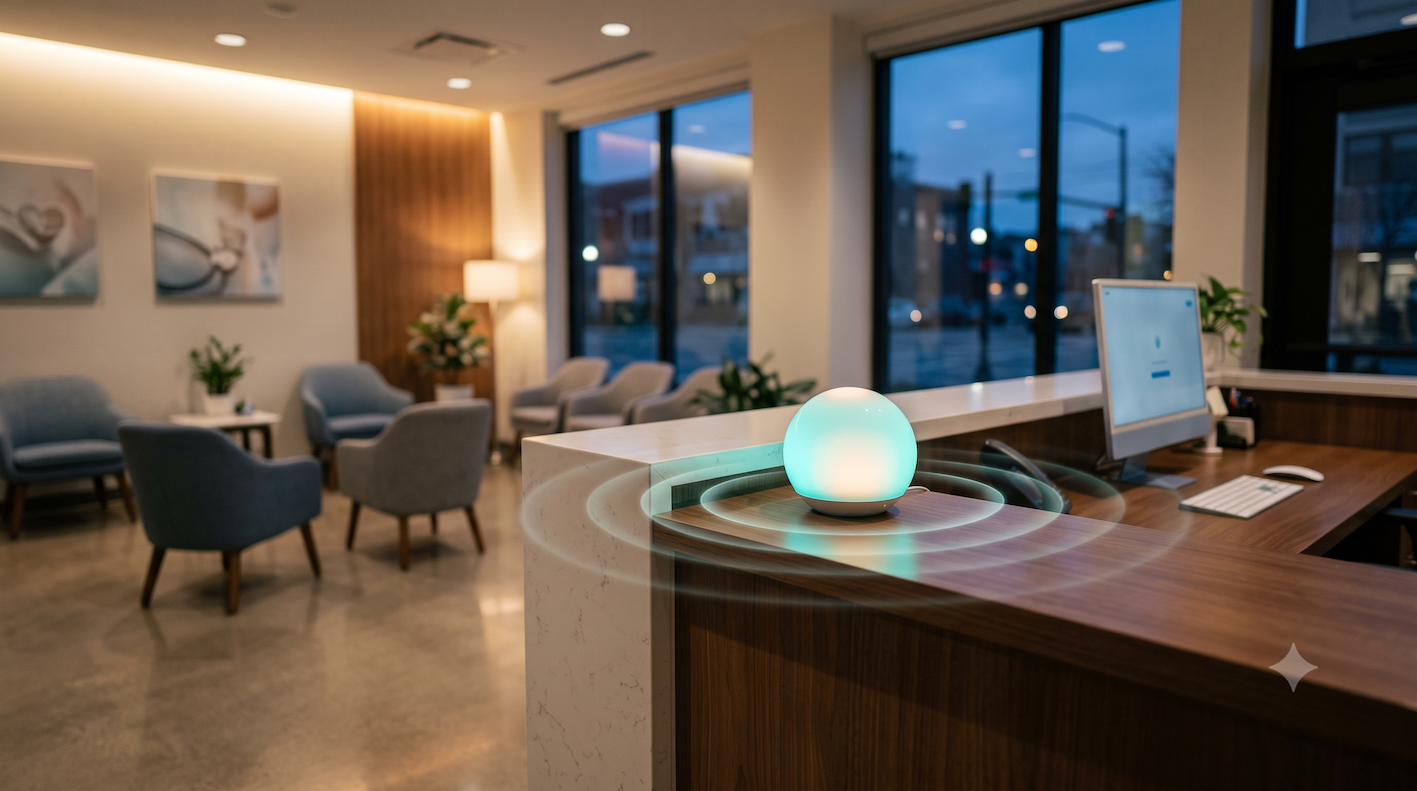
For years we treated the front desk as overhead: a cost center to be staffed as thinly as tolerable, measured by call volume and hold times. That framing is now backwards. The front desk is where care begins or stalls. It is the first and most frequent point of contact a patient has with your organization, and it has quietly become the single highest-leverage place in a practice to apply AI.
The economics hiding in plain sight
Start with the money, because that's where the problem is easiest to see and hardest to defend.
A missed call isn't a neutral event. In most practices, a meaningful share of inbound calls go unanswered during business hours — and the overwhelming majority go unanswered after them. Each of those is a patient who wanted something: to book, to reschedule, to ask whether their symptom warrants a visit. When no one answers, some fraction call back. The rest go to a competitor, to urgent care, or nowhere at all.
Now layer on the cancellations and no-shows. A slot that empties out 12 hours before the appointment is almost never refilled, because refilling it requires someone to notice, pull the waitlist, and make a round of calls that the front desk doesn't have time for. Multiply an unfilled slot by a full schedule, across every provider, every week, and the leak becomes a river.
The reactivation problem is subtler but larger. Every practice is sitting on a list of patients who lapsed — people who missed a follow-up, finished a treatment plan, or simply drifted. Reaching back out to them is textbook high-value work, and it is almost always the first thing that falls off a busy front desk's plate. The revenue is real; the labor to capture it just never exists.
The point isn't that practices are badly run. It's that the human front desk has a hard ceiling, and everything above that ceiling leaks. You cannot hire your way past it economically, and you cannot ask your existing staff to simply work faster.
From answering machines to agents
Here's where most conversations about "AI for the front office" go wrong. The instinct is to lump it in with the phone trees and website chatbots patients already resent — systems that ask you to describe your problem three times and then route you to a queue.
There is a categorical difference between a system that routes a call and one that completes the work.
An agent doesn't take a message about rescheduling — it checks the calendar, offers real openings that fit the patient's constraints, books the slot, and updates the EHR so the change is real everywhere it needs to be. It doesn't hand a patient a form to maybe fill out later — it collects the intake in natural conversation, in the patient's own words, at 9 p.m. on a Sunday, and delivers it structured and ready for the clinician. It doesn't just field a triage question — it works from your clinical protocols to decide what's routine, what needs a nurse, and what needs to be escalated immediately.
That shift — from deflection to completion — is what changes the economics. You are no longer buying a way to survive overflow. You are recovering the appointments, follow-ups, and reactivations that used to leak out of the system entirely, and you are doing it around the clock without adding headcount or asking your team to absorb more.
Why healthcare is different — and why that's the whole point
It's fair to be skeptical. Generic automation has a bad track record in healthcare, and for a good reason: the stakes are clinical.
A missed urgent symptom, a wrong answer to a medication question, a fumbled handoff between the automated system and a human — these aren't UX bugs, they're patient safety events. A chatbot that's 95% helpful and 5% dangerous is not a product you can put in front of patients. This is exactly why the answer isn't a smarter chatbot bolted onto a website.
What healthcare actually requires is an agent that operates inside clinical guardrails rather than around them. That means knowing the boundaries of what it should handle and escalating cleanly the moment a conversation crosses them. It means recognizing red-flag language and routing urgent scenarios to a human without hesitation. It means treating compliance — HIPAA, SOC 2, the handling of protected health information — as a starting condition rather than a feature added late. And it means integrating with the systems clinicians already live in, so the work an agent does is real and visible inside Epic, Athena, Cerner, and the rest, not stranded in a separate tool nobody checks.
Constraints like these are usually framed as what makes healthcare hard for AI. In practice they're what makes a purpose-built agent valuable. Anyone can deploy a generic bot. The organizations pulling ahead are deploying agents designed for the one environment where getting it wrong isn't an option.
The decision in front of you
The competitive gap over the next few years won't be between practices that adopt AI and practices that don't. Everyone will adopt something. The gap will be between two very different uses of it.
Some practices will use AI to shave a few minutes off staff workload — a marginally faster phone tree, a slightly better auto-responder. Real, but small. Others will use it to close the loops that were quietly costing them patients: the unanswered call at 8 p.m., the cancellation that never gets refilled, the lapsed patient who was never called back. That's not an efficiency gain. It's a structural change in how much of your demand actually converts into care delivered.
The sharper question to ask isn't "should we use AI at the front desk?" It's "which patient interactions can we now guarantee never go unanswered?" — and then working backward from that guarantee.
Healthcare doesn't stop when the office lights go off. Increasingly, neither does the expectation of care. The practices that win the next few years will be the ones that stopped treating the front desk as a cost to minimize — and started treating it as the front line it always was.
Ready to see what unbroken patient access looks like? That's the problem we built PuppeteerAI to solve.
Let’s build your next care agent together
Get a 20-minute call with our team to explore how Puppeteer AI can support your clinical workflows with custom AI agents.


Last Articles


Real Usecases, Real Results
See how healthcare teams use Puppeteer AI to automate patient conversations, reduce workload, and deliver better care, from intake to reactivation.